
Robot
HOME  >  APPLICATION  >  Robot


Robot Application Scenario


Core Scenario Requirements

The scenario needs to adapt to robot operating characteristics such as frequent start-stop, strong vibration, and limited installation space. Core material requirements include miniaturization, lightweight design, high power density and fast response speed. It solves typical pain points of industrial and humanoid robots, including servo system overheating, control delay, insufficient positioning accuracy, and excessive overall volume.


Specific Applications of Six Major Products


  1. Single/Polycrystalline Diamond Substrates & Heat SinksApplied to 3D vision laser chip substrates and high-precision force sensor heat sinks for robots.Single-crystal diamond substrates improve the detection accuracy and service life of laser cameras, enhancing the robot’s visual positioning and grasping precision. Meanwhile, their ultra-high thermal conductivity ensures temperature stability of high-precision sensors, avoids measurement errors caused by temperature drift, and improves the robot’s perception and control accuracy.
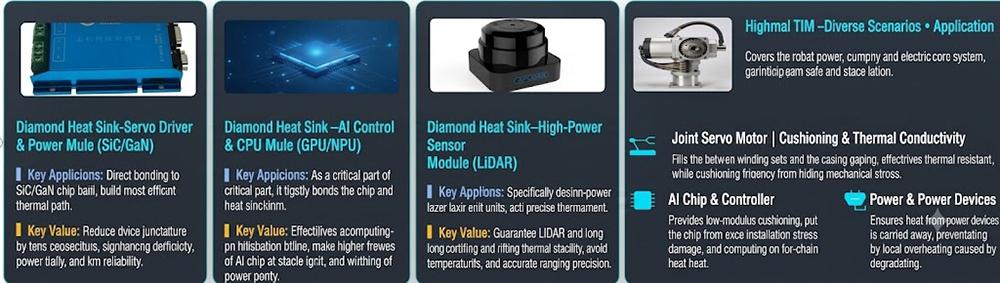
  2. Diamond Composite Heat Sinks & EnclosuresUsed for power module heat sinks of robot servo drives, housings of machine vision laser cameras, and heat dissipation structures of high-precision force sensors.With lightweight and high thermal conductivity features, diamond‑aluminum composite heat sinks solve heat dissipation difficulties in the confined space of servo drives, improving the response speed and overload capability of servo systems. In addition, the high rigidity of the enclosures guarantees the mounting accuracy of laser cameras and force sensors, further enhancing the robot’s visual positioning and object-grasping performance.
  3. M9/M10 Copper-Clad Laminates & TVG Glass SubstratesApplied to robot servo drive control boards, high-speed image processing boards for machine vision, and real-time bus communication boards of industrial robots.Extremely low dielectric loss ensures distortion-free transmission of servo control signals and high-speed image signals, improving the control accuracy of servo systems and the response speed of machine vision, and meeting high-speed communication requirements of real-time buses such as EtherCAT for industrial robots. At the same time, high thermal conductivity resolves heat dissipation issues of drive boards and improves the reliability of robot systems for 7×24-hour continuous operation.
  4. Aluminum Silicon Carbide (AlSiC)Mainly used for servo motor housings, reducer housings, and joint module structural parts of industrial and humanoid robots.Featuring high specific stiffness and lightweight properties, AlSiC reduces the weight of traditional aluminum alloy housings by 30%, greatly lowering the load and moment of inertia of robot joints and improving motion speed and positioning accuracy. Its excellent thermal conductivity also solves overheating under high power density operation of servo motors, increasing continuous output power and service life. It is a core material for the miniaturization and lightweight design of humanoid robot joints.
  5. Customized Diamond Heat Dissipation ModulesCustomized heat dissipation solutions for high-computing main control units of humanoid robots, machine vision systems of industrial robots, and collaborative robot controllers.Designed to fit the narrow installation space of robot main control units, it enables fanless passive heat dissipation. Compared with traditional solutions, the volume is reduced by 50% and heat dissipation efficiency is increased by more than 3 times. It breaks the thermal bottleneck of high-performance main control chips and improves the response speed and computing capability of robot control systems. Meanwhile, the fanless design lowers robot noise and meets silent operation demands in industrial and service scenarios.
  6. Quantum DiamondApplied to high-precision tactile/force sensors, ultra-high-precision inertial navigation systems, and nanoscale displacement sensing systems of humanoid robots.Quantum diamond sensors based on NV color centers realize nanoscale force and displacement measurement, with accuracy far exceeding traditional strain gauge sensors, greatly improving the fine operation capability of humanoid robots (such as precision assembly and medical surgical robots). In addition, quantum diamond inertial navigation systems support autonomous operation in complex environments without external positioning signals, fully meeting the operational demands of unmanned industrial factories and special-purpose robots.