
TEL:13526590898
 Scan to contact us
 Scan to view the mobile version


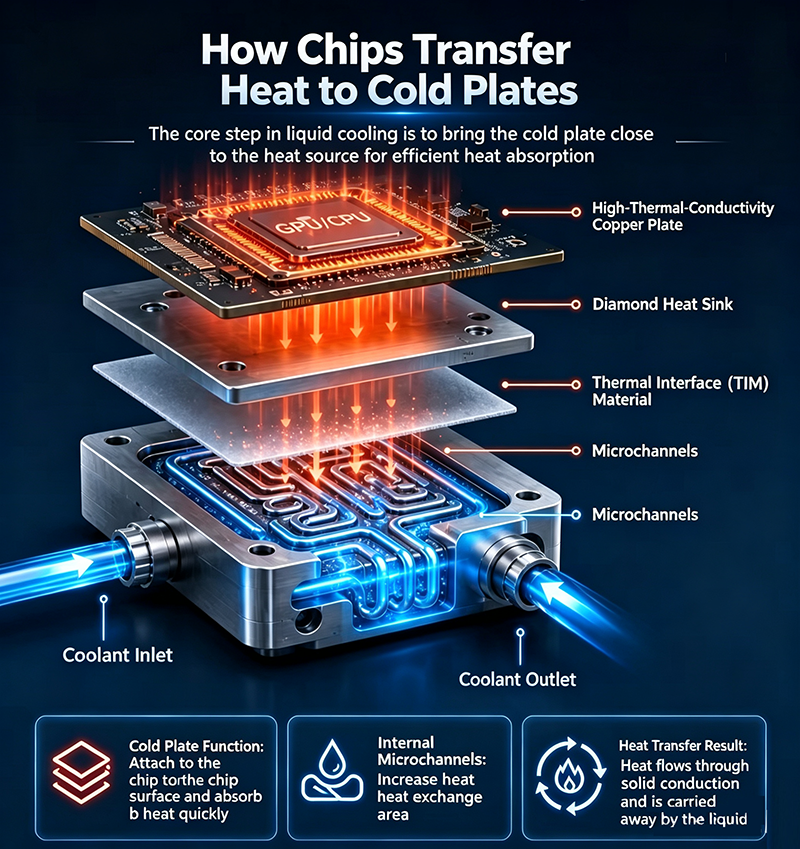
Panoramic View of Our Products' Heat Dissipation Applications at the Chip Level
Deep-Dive Analysis of Chip Liquid Cooling Thermal Path
Today’s high-end AI chips employ a mainstream five-tier vertical liquid cooling architecture. The diagram below illustrates the complete heat flow path — from the chip core to the final removal by coolant.
Heat Flow Path
Chip → High-Thermal-Conductivity CCL → Diamond Heat Spreader → Thermal Interface Material (TIM) → Micro-Channel Liquid Cold Plate
Key Functions of Each Tier
GPU/CPU: Heat source core
High-Thermal-Conductivity CCL: Thermal diffusion bridge for packaging
Diamond Heat Spreader: Rapidly spreads point-source hotspots into planar heat flow
Thermal Interface Material (TIM): Diamond-based high-thermal-conductivity TIM fills microscopic gaps
Micro-Channel Liquid Cold Plate: Final heat exchange interface
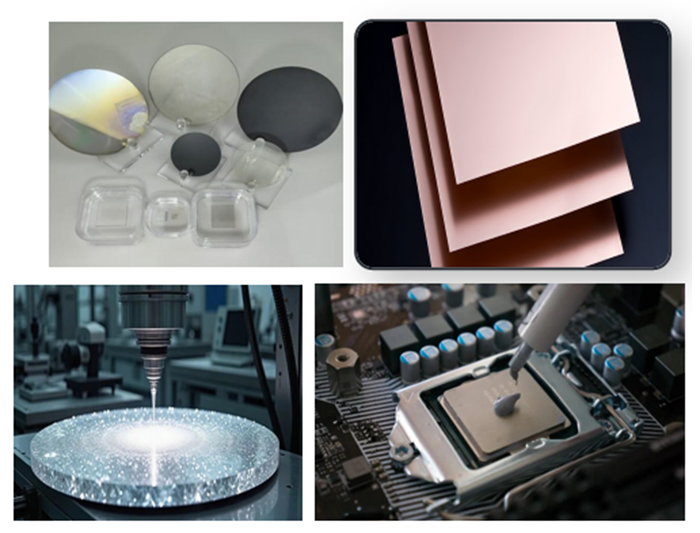
In thermal management applications for high-power-density chips (such as SiC/GaN power devices, AI computing chips, and RF/laser chips), diamond-based materials leverage a thermal conductivity far superior to traditional metals and ceramics to overcome thermal bottlenecks across the entire thermal pathway—from the die level, to the package substrate, through the thermal interface, and up to the system level.
1. Single-Crystal / Polycrystalline Diamond Substrates
Applications: Chip substrates, die-level heat spreaders, and the core foundation for the entire portfolio of diamond thermal management products.
Target Devices: RF GaN, high-power laser chips, SiC power devices, and AI computing chips.
2. Diamond-Cu / Al / SiC Composites
Applications: Package-level heat spreaders and chip mounting bases.
Target Devices: IGBTs, automotive SiC power chips, and aerospace avionics chips.
3. High-Thermal-Conductivity & High-Adhesion Thermal Gels (TIMs)
Applications: Full-pathway gap filling at the die-to-heat-spreader and substrate-to-cold-plate interfaces.
Target Devices: All categories of high-power chips; specifically optimized for diamond-based thermal management systems.
4. Metallized Diamond Substrates (AMB/DPC) & Copper Clad Laminates (CCL)
Applications: Power packaging substrates, IC substrates (chip carriers), and precision routing substrates.
Target Devices: SiC power modules, industrial IGBTs, 5G RF, optical communication chips, and 2.5D/3D advanced packaging.
Note: These enable circuit integration on insulating diamond substrates, serving as the key enabler for integrating diamond into chip packaging systems.
5. Diamond Wafer Substrates & Chip-Level Heat Spreaders
Processing Routes: Available in two routes: Wafer Bonding and Direct Deposition.
Applications: Epitaxial substrates for chips and backside-bonded die heat spreaders.
Target Devices: RF GaN chips, laser chips, AI/GPU bare dies, and 3D stacked chips.