
Scan to contact us
Scan to view the mobile version

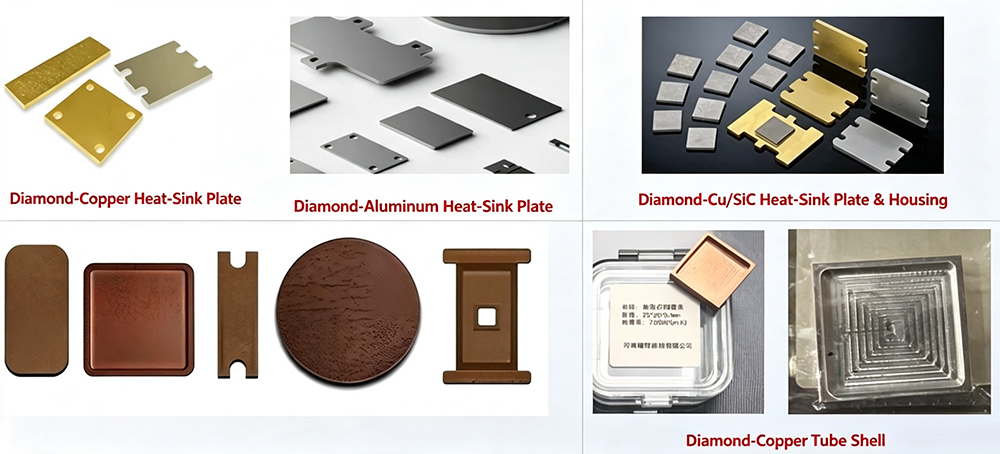
Diamond composite heat sink

Product Introduction:
Diamond copper, diamond aluminum, diamond molybdenum, and diamond silicon carbide heat sinks are all diamond particle-reinforced composite materials. As the core heat dissipation carriers for high-power devices, this series of heat sinks boasts high thermal conductivity, low thermal expansion coefficient, high mechanical strength, excellent thermal stability, and good packaging adaptability. They can quickly dissipate the concentrated heat generated by device operation, significantly reduce chip junction temperature, and enhance device power density and long-term reliability.
The material system possesses functions such as structural support, stress buffering, and thermal expansion matching, effectively mitigating the thermal mismatch issue between the chip and the packaging shell, and reducing the risks of thermal cycle fatigue and interface failure. Additionally, it features high temperature resistance, corrosion resistance, low dielectric loss, metallizability, and bondability, meeting the heat dissipation and structural support requirements of semiconductor devices, radio frequency modules, laser devices, and aerospace equipment under harsh operating conditions.
Diamond composite material shell

Product Introduction:
Diamond copper, diamond aluminum, diamond molybdenum, and diamond silicon carbide casings possess the following functions: Structural Load-Bearing and Mechanical Protection: Serving as the external casing of the device, they provide sufficient rigidity and strength to encapsulate and secure chips and components, resist external impact, vibration, and wear, and protect the integrity of internal components.
Efficient heat dissipation and thermal management: It combines the dual functions of a housing and a heat sink, quickly dissipating the heat generated by the device, reducing internal temperature rise and hot spot concentration, and enhancing power density and operational stability.
Thermal expansion matching and stress buffering: The thermal expansion coefficient is compatible with the internal chip and substrate materials, reducing thermal stress caused by temperature cycling and avoiding cracking, delamination, and solder fatigue failure.
Environmental sealing and reliability protection: Forming a closed cavity to achieve dustproof, moisture-proof, and corrosion-resistant properties, with some materials capable of withstanding high temperatures and radiation, meeting the demanding requirements of aerospace, automotive, military, and other harsh environments.
Electromagnetic compatibility and electrical compatibility: Conductive housing (diamond copper, aluminum, molybdenum copper) can achieve electromagnetic shielding; insulating housing (SiC, diamond-SiC) can achieve high-voltage insulation and isolation, ensuring electrical safety.
Packaging process compatibility: It can perform processes such as metallization, soldering, bonding, and sintering, and is highly compatible with the packaging processes of semiconductors, optoelectronics, and RF modules.
Dimensional stability and long-term reliability: no deformation, no phase transformation, and minimal performance degradation under high temperatures, ensuring the accuracy and longevity of the device under long-term operation and complex working conditions. Example 1